





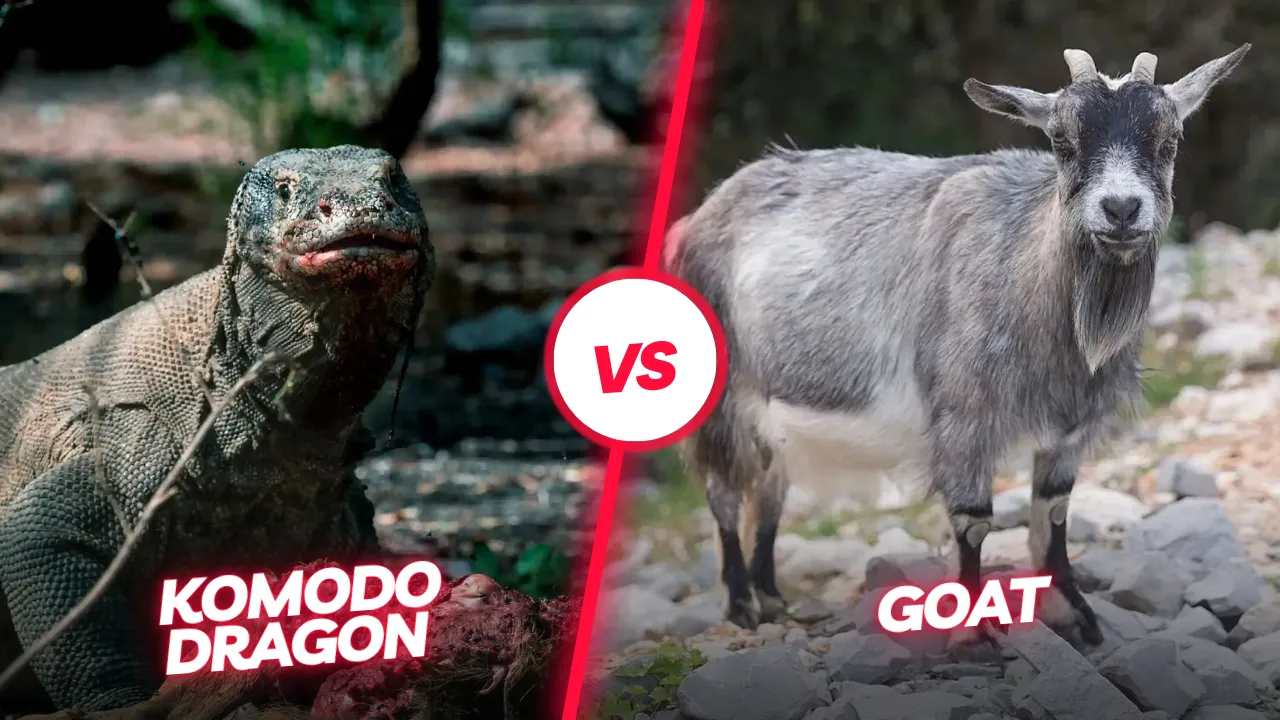
Have you ever imagined what would happen if a Komodo dragon and a goat ended up in the same arena in the wild? Believe it or not, this could actually occur when a local’s goat wanders off and crosses paths with the giant lizard. The Komodo dragon, famously known as Indonesia’s enormous reptile, offers a wealth of fascinating facts. Meanwhile, goats—widely recognized farm animals around the globe—have their own intriguing characteristics. But how would things turn out if these two creatures with vastly different backgrounds really faced each other in real life?
Komodo Dragon: The Silent Killer
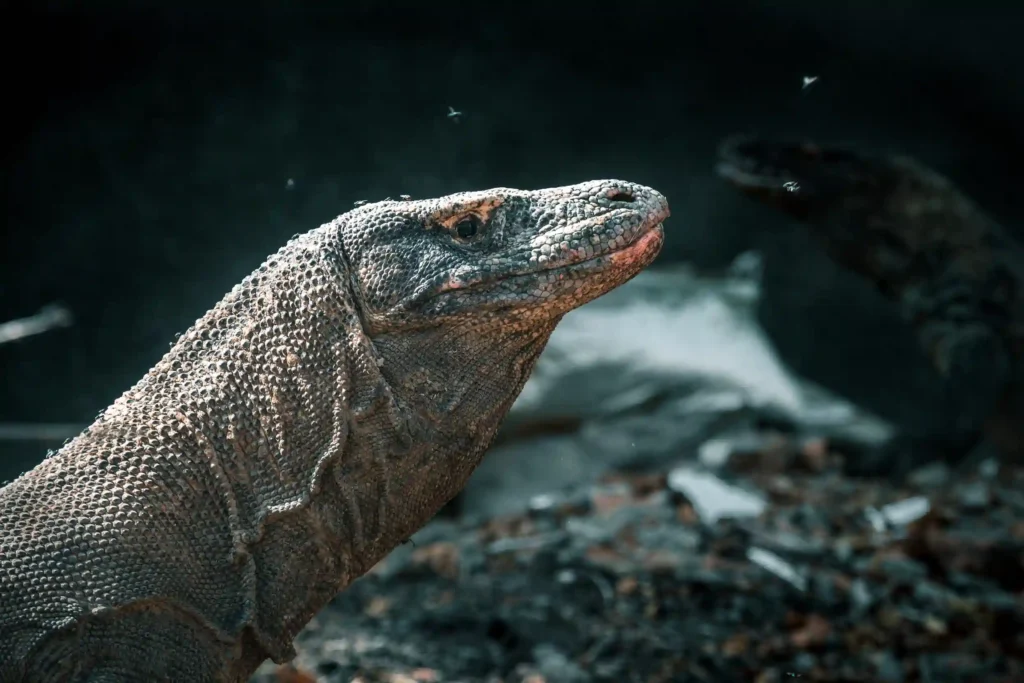
A Komodo dragon, or simply “Komodo,” is one of Indonesia’s most renowned animals worldwide. Its striking appearance can reach up to three meters in length, earning it the title of the largest lizard on Earth. The fierce Komodo dragon is a true carnivore; in its native habitat, it often preys on wild boars or deer roaming around Komodo Island and Rinca Island. Their serrated teeth and saliva teeming with deadly bacteria form a dangerous combination that makes it extremely tough for prey to escape once bitten.
The Komodo’s tough, brownish scales help it blend in among bushes and dry grasslands. Although it might look somewhat stiff, this reptile has strong muscles, plus a tail that works like a powerful whip to knock down prey or fend off enemies. Its forked tongue flicks in and out to pick up scent molecules in the air, giving it a big advantage when tracking other animals—whether they’re alive or already carcasses. When hungry, a Komodo dragon can move surprisingly fast over short distances, lunging at its target in a sudden attack. Another remarkable trait is that it can swallow prey amounting to 80% of its own body weight. That’s why any animal, including a goat, is easy game if it gets too close.
Komodo dragons live mainly in Komodo National Park and the surrounding islands, where the landscape consists of dry savannas, shrubs, and rocky beaches. Here, they reign as the apex predator with hardly any real rivals aside from other big Komodos. Though their population is relatively small, intensive conservation programs led by the Indonesian government and various global organizations help protect these “last dragons on Earth.”
Goat: the Gentle Herbivore

In contrast to the Komodo dragon, goats have long been domesticated and live side by side with humans. They’ve been used for thousands of years for meat, milk, and even hide. You can find them just about everywhere in the world, thanks to their impressive adaptability.
Goats are herbivores, feeding on grass, leaves, and a variety of plant matter. Their curiosity often drives them to nibble on anything green or pleasantly scented. They come in many sizes but generally weigh somewhere between 20 and 60 kilograms. Male goats (bucks) usually have horns that can be used in a scuffle or to compete for females. However, compared to many wild animals, goats aren’t really equipped for high-stakes combat—especially when facing a powerful predator. Goats are also cherished as pets due to their friendly nature.
In many Indonesian villages, goats roam around open fields or near houses. Their friendly nature and relatively quick breeding cycle make them a valuable economic asset for local farmers. But if a goat happens to wander into the wild, there’s a real chance it could have an unexpected encounter with a Komodo dragon—especially on islands where these giant lizards roam freely.
Read more: Komodo Dragon vs Elephant: A Fun Comparison of Two Mighty Giants
Komodo Dragon vs Goat: A Comparison
Although these two creatures seem worlds apart in terms of appearance, behavior, and survival strategies, there are certain situations that might put them on a collision course. The Komodo dragon is a distinct species with unique adaptations.

Comparison Table: Komodo Dragon vs Goat
| Aspect | Komodo Dragon | Goat |
| Classification | Carnivore | Herbivore |
| Typical Habitat | Komodo & Rinca Islands (dry savanna, shrubs, rocky shores) | Domesticated farmland, fields, near human settlements |
| Body Size | Up to 3 meters long, weighs 70–90 kg | Usually 20–60 kg, around 50–100 cm tall at the shoulder |
| Diet | Wild boars, deer, sometimes goats or carcasses | Grass, leaves, various plants |
| Defense Mechanisms | Strong bite, sharp claws, tail whip, bacterial venom in saliva | Horns (in males), kicking, typically relies on fleeing |
| Hunting Behavior | Stealth ambush predator, can swallow prey up to 80% of its own weight | None (pure herbivore), does not hunt |
| Chance of Encounter | High if goats stray into Komodo habitat | Possible when goats graze near Komodo territory |
| Outcome in a Clash | Komodo’s lethal bite is often decisive | Low odds alone; may escape if Komodo is distracted or fails to land a fatal bite |
Physical Characteristics and Size
A Komodo dragon doesn’t look anything like your everyday lizard. Its body can stretch beyond three meters, weighing somewhere between 70 and 90 kilograms. Its thick, scaly skin acts as armor against rocks or clashes with other animals. Meanwhile, goats usually stand around 50 to 100 centimeters tall at the shoulder. Their pupils are horizontally shaped, unlike the forward-facing, intense gaze of the Komodo, which contributes to the dragon’s fearsome look.
Eating and Hunting Habits
A Komodo dragon is a predator that hunts for food, typically targeting animals smaller or roughly the same size as itself. Wild boars and deer on Komodo or Rinca are its usual prey. But if there’s a lone goat that’s strayed off course, a Komodo dragon won’t hesitate to seize the chance. After biting, it often lets its prey weaken from bacterial toxins in its saliva, tracking it by following any blood trail or distinct scent in the air.
Goats, on the other hand, don’t “hunt” anything. They’re pure plant-eaters who spend their days grazing on grass or bushes. They generally steer clear of any area that smells like a predator, but sometimes a goat might wander out of curiosity, completely unaware it’s stepping into Komodo territory.
Defense
When cornered, a Komodo dragon relies on its powerful bite, sharp claws, and a tail strike that can be devastating. A goat, in contrast, has horns or a kick to defend itself. Still, the goat’s strength is no match for a Komodo dragon’s sudden ambush and bone-crushing jaws.
Habitat and Chances of Encounter
On Komodo and Rinca, the dragons have long roamed as dominant wild predators. These islands also host small villages where people keep goats. It’s not uncommon for goats to graze near savannas or coastal areas where Komodos wander. This overlap increases the odds they’ll meet. While it’s not widely reported, some locals say they’ve lost goats, likely seized by Komodo dragons.
The danger is especially high if a Komodo is hungry or if a younger dragon wants to prove itself. And since it can gulp down prey weighing up to 80% of its own body mass, a goat is an easy target indeed. The Komodo dragon can deliver a venomous bite that incapacitates its prey, making it even more lethal.
Komodo Dragon vs Goat: Who Would Win?
Komodo dragon swallows a whole goat in seconds pic.twitter.com/zOZACCtldy
— . (@soichaao) February 9, 2025
Picturing a Komodo dragon and a goat in the same space might bring to mind a dramatic wildlife documentary—a panicked goat, a drooling Komodo dragon poised to pounce. This is closer to reality than you might think. Watch videos of such encounters with caution, as they can be graphic and unsettling.
Because it’s a natural predator, a Komodo almost always comes out on top. No matter how hard a goat fights back, it’s nearly impossible to withstand a Komodo’s lethal bite. Along with its claws and strong jaws, the Komodo’s bacteria-laden saliva leaves wounded prey with little hope if the bite is deep enough.
Meanwhile, goats aren’t built for life-or-death battles. They depend on running away or staying in groups. If a goat is alone in the wild, its chance of escaping is slim. On rare occasions, a goat might manage to flee—usually if the Komodo doesn’t land a fatal bite or gets distracted.
Read more: Komodo Dragon vs Electric Eel: Unique Creatures of Land and Water
Feel the Real Adventure: Book a Komodo Tour with Komodo Luxury
A Komodo dragon and a goat sit at opposite ends of the animal kingdom. The Komodo is a powerful carnivore whose adaptations let it take down prey close to its own size. The goat is a gentle herbivore that has been close to humans for countless generations.
After reading about this potential Komodo dragon vs goat showdown, you might be visualizing the battle in your mind. If you’re used to seeing goats in everyday life, maybe this is the perfect cue to witness Komodo dragons in their natural habitat. Visitors can even capture videos of Komodo dragons in their natural habitat, making the experience even more memorable.
Visiting Komodo Island is a fantastic choice, especially for thrill-seekers who want to experience the rush of encountering these incredible creatures in the wild. One of the best ways to do that is with Komodo Luxury.

Komodo Luxury offers much more than just opportunities to photograph Komodo dragons. You’ll gain insights into their behavior, conservation efforts in the region, and how local communities coexist with these formidable predators. Their tour boats are well-equipped and comfortable, featuring air-conditioned cabins and delicious meals throughout the journey. You can explore multiple islands, soak up the pink-sand beaches, and even go snorkeling in pristine waters teeming with marine life.
Experienced rangers lead the tours, ensuring everyone’s safety and safeguarding the local ecosystem. They’ll show you around responsibly, focusing on both visitor protection and the welfare of the flora and fauna in Komodo National Park. This way, you get to satisfy your curiosity about these legendary animals while supporting responsible tourism.
Already can’t wait to see a Komodo dragon in person? Book your Komodo tour with Komodo Luxury now!